09/28/2026
What Is a Jewelry Setting? A Beginner's Guide to Choosing Yours
If you've started shopping for an engagement ring, you've probably run into the word "setting" more times than you can count-and if you're not sure what it means, you're not alone. It's one of the most searched, least explained terms in fine jewelry.
In simple terms, a setting is the metal structure that holds your diamond or gemstone in place. It's not just a technical detail - it determines how secure your stone is, how much light reaches it, and how the whole ring reads on the hand. Get the setting right, and everything else about the ring - the shape, the carat, the metal - falls into place. To see the full range of options side by side, explore our engagement ring settings collection before you dive into the details below.
What Does "Setting" Actually Mean?
Every setting is built from the same basic parts: a base (sometimes called a basket) that anchors the stone, and some kind of hold - prongs, metal walls, or a groove - that keeps it from moving. How a jeweler arranges those parts separates a solitaire from a halo, or a bezel from a pavé band.
The setting also decides how much of the diamond's girdle (the widest part of the stone) is exposed. More exposure generally means more sparkle, but less protection. Less exposure means more durability, but a slightly more contained look. Neither is "better" - it depends on how you live in your ring day to day.
The Most Common Setting Styles
Solitaire. A single center stone held up by a few slim prongs, usually four or six. It's the classic choice because it puts all the attention on the diamond itself. If you want maximum brilliance with minimal distraction, a solitaire setting is the benchmark everyone else is compared against.
Halo. A ring of smaller accent diamonds circles the center stone, making it look noticeably larger and adding extra shimmer from every angle. A halo setting is a popular pick for anyone who wants more visual impact without upsizing the center diamond.
Hidden halo. A variation where the halo sits beneath the center stone rather than around it, so it's only visible from the side. It's a quieter, more modern take on the same idea - if you're torn between the two, we've compared the two styles in more detail to help you decide.
Three stone. A center diamond flanked by two smaller stones, often used to represent a couple's past, present, and future. A three stone setting also tends to make the center stone look larger by adding width to the hand.
Settings Built for Everyday Durability
If you work with your hands, play sports, or just tend to bump your ring on things, security matters as much as sparkle.
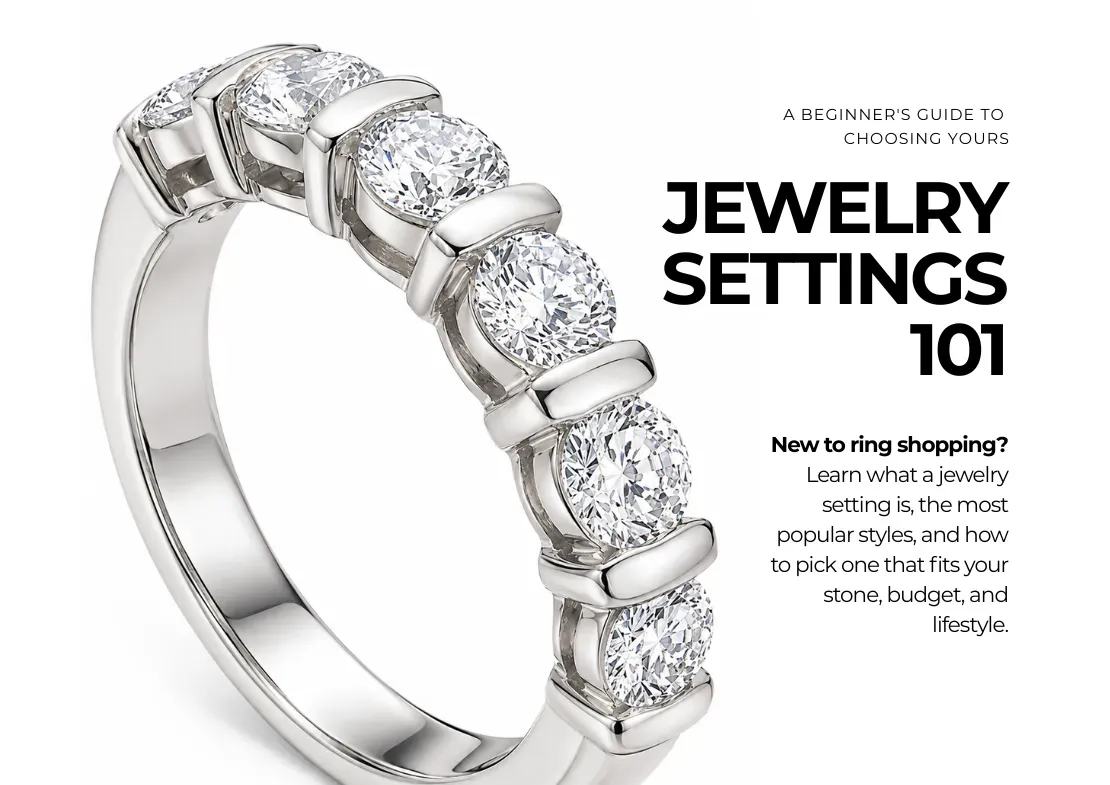
A bezel setting wraps a thin metal rim fully or partially around the stone, making it one of the most snag-resistant options available - ideal for active lifestyles. A channel set band tucks smaller diamonds into a groove along the band with no visible prongs, so there's nothing to catch on clothing or hair. And a pavé setting lines the band with tiny, closely-set diamonds for continuous sparkle without adding bulk.
Prong shape plays into this too - even small differences change how securely a stone sits and how the setting catches light. If you're comparing options, here's how prong shapes affect security in everyday wear.
How to Choose the Right Setting for You
Start with how you actually live. Someone who takes their ring off for manual work has different needs than someone who wears it 24/7 at a desk job. From there, think about the look you're drawn to - more sparkle and presence, or something cleaner and lower-profile.
It's a decision that outlasts the "yes." The setting you choose now is the one you'll be cleaning, resizing, and living with for years, which is part of why this decision matters long after the proposal.
Also worth factoring in: the stone itself. Certain shapes pair better with certain settings - an elongated stone like an oval or marquise often benefits from a setting with extra side protection, while a round brilliant works beautifully in almost any style. If quality and certification matter to you (and they should), look for GIA-certified diamonds regardless of which setting you land on, since the 4Cs are what the setting is ultimately showing off.
Bringing It All Together
A jewelry setting isn't just a technical piece of the puzzle - it's the difference between a ring that photographs well and one you'll actually love wearing every day. Once you understand the basics of how settings work, the rest of the shopping process gets a lot easier, because you're no longer guessing at unfamiliar terms.
If you want to go deeper into style options before making a decision, see all 18 setting styles in detail - it's a good next stop once you know what you're looking for.
Ready to see them in person? Browse our diamond engagement ring settings and find the one that fits your style, your stone, and how you actually live.